You open an investment presentation and turn to year ten. The rents are higher, the renovations are finished, and a buyer pays a price that produces an attractive return. It looks convincing. But how much of that result comes from work the manager can do, and how much depends on someone paying the right price a decade from now?
A long holding period can be sensible. Some assets justify patient ownership, and a hurried sale can undermine a sound operating plan. Our concern is different. A distant exit date can make unresolved questions look as though they have been answered simply because the spreadsheet extends far enough into the future.
At BlackGuard, we want a plain explanation of how the investment is supposed to make money. What needs to improve? Who will do the work? What happens if the sale takes longer? Time is part of that plan. It cannot answer those questions for us.
What will happen while your money is invested?
A holding period describes how long an investment is expected to remain in place. A business plan explains what management intends to accomplish during that time. Acquiring a property, improving operations, maintaining its competitive position, and deciding whether to sell involve different decisions and different evidence.
In a hypothetical apartment acquisition, the sponsor expects to renovate interiors and increase rents. The holding-period assumption does not establish whether residents want those improvements, whether the proposed rent is affordable, or whether the work can be completed within the budget. Those questions must be answered on their own terms.
Ask which part of the expected result comes from operating improvements and which part comes from a future buyer's valuation. If most of the anticipated gain appears only at sale, the assumptions behind that sale deserve substantial attention. A smooth line between acquisition and exit should not hide that dependence.
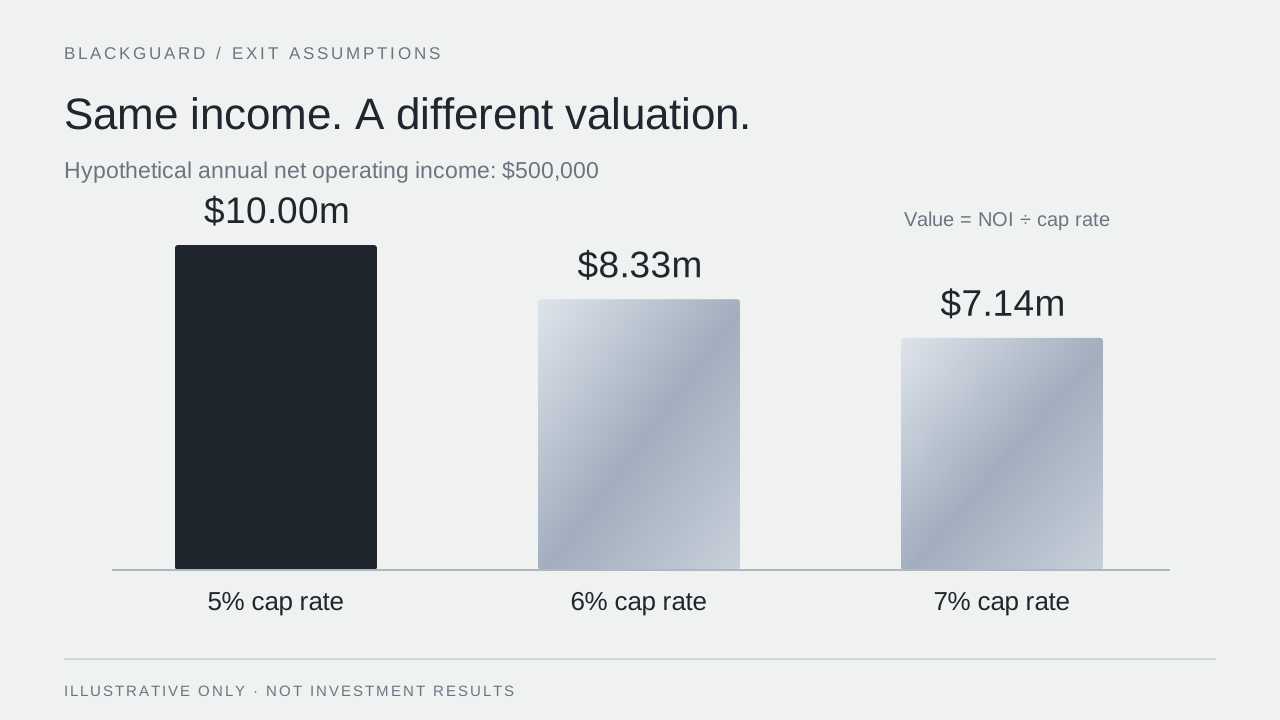
The illustration above holds hypothetical annual net operating income at $500,000. Dividing it by a 5% capitalization rate implies $10 million of property value; using 7% implies about $7.14 million. Nothing changed about the income in that simplified comparison. The valuation assumption changed. This is not an appraisal or an investor-return calculation, but it shows why the assumed exit deserves its own test.
More years create more opportunities for conditions to change
Over an extended period, new housing can enter the market, resident preferences can change, and operating expenses can move in ways the original budget did not anticipate. Construction methods and product design may also evolve. The possibility of change does not establish its direction or timing, but excluding it is still an assumption.
That is particularly important when a thesis depends on today's competitive set remaining familiar. The relevant question is not only how the property compares with existing neighbors. It is how the property might compete with a different product at a different price. Our discussion of construction innovation and replacement cost treats that possibility as a scenario to test.
Do not replace one certainty with another. Predicting that every older apartment building will become obsolete is no more disciplined than assuming none will. The work is to identify which changes would matter to this asset and what evidence would prompt a response.
The loan may come due before you want to sell
A property can have a ten-year ownership objective and a much earlier debt maturity. That difference matters. If repayment depends on refinancing, the investment must satisfy a future lender's requirements under future market conditions. An operating plan that remains attractive on paper may still face a financing problem.
In its November 2025 Financial Stability Report, the Federal Reserve discussed the potential for distressed commercial-property sales when borrowers cannot refinance. That is dated market context, not a forecast for any specific BlackGuard opportunity. It illustrates why access to financing belongs inside the ownership analysis.
Review the maturity schedule, extension conditions, reserves, interest exposure, and consequences of missing a milestone. The OCC's 2024 refinance-risk guidance, written for banks, likewise identifies asset performance, timing, market liquidity, and refinancing cost as relevant considerations. An investor need not operate a bank to understand why those variables matter.
Could you keep owning it if the sale did not happen?
An investment does not become resilient merely because management says it can hold longer. A longer hold needs cash to pay operating expenses, financing obligations, and required capital work. It also needs investors whose circumstances can accommodate the delay.
For the hypothetical apartment property, compare an expected sale with continued ownership under less favorable conditions. Would operating cash cover the ongoing requirements? Which improvements are optional, and which protect the property's ability to function? What happens if a major repair arrives before the expected refinancing?
The answer may be that more equity or a different financing structure is necessary. It may also be that the opportunity does not make sense at the proposed price. The purpose of the exercise is to inform the investment decision, not to decorate an unchanged recommendation with a downside appendix.
Build review points into the plan
A ten-year model can still support active management if there are clear points for reassessing it. Set out the milestones that should produce new evidence. Examples include completed work, actual leasing results, changes in competing supply, and the approach of a debt maturity. Explain who reviews the evidence and what decisions are available.
Suppose renovated units lease more slowly than expected while unrenovated units remain competitive. That result deserves analysis before repeating the same renovation across the property. The original plan may need adjustment, even when its long-term objective has not changed.
Useful reporting distinguishes a temporary timing difference from a weakened investment thesis. It should also explain uncertainty. A manager may be gathering evidence rather than possessing a final answer. What matters is whether the issue, responsibility, and next decision are visible to investors.
Does a shorter strategy solve the problem?
No. A shorter horizon reduces the period over which some assumptions must hold, but it can concentrate execution pressure. A delayed permit, difficult refinance, or weak sales market can interfere with a short plan just as it can a long one. Repeated transactions may also bring additional costs.
The reason to consider a shorter investment is that there is specific work to complete and a believable way to get paid when that work is done. That can give an investor another opportunity to put returned capital to use. The proposed timeline should fit the work, rather than be chosen because an earlier date sounds reassuring.
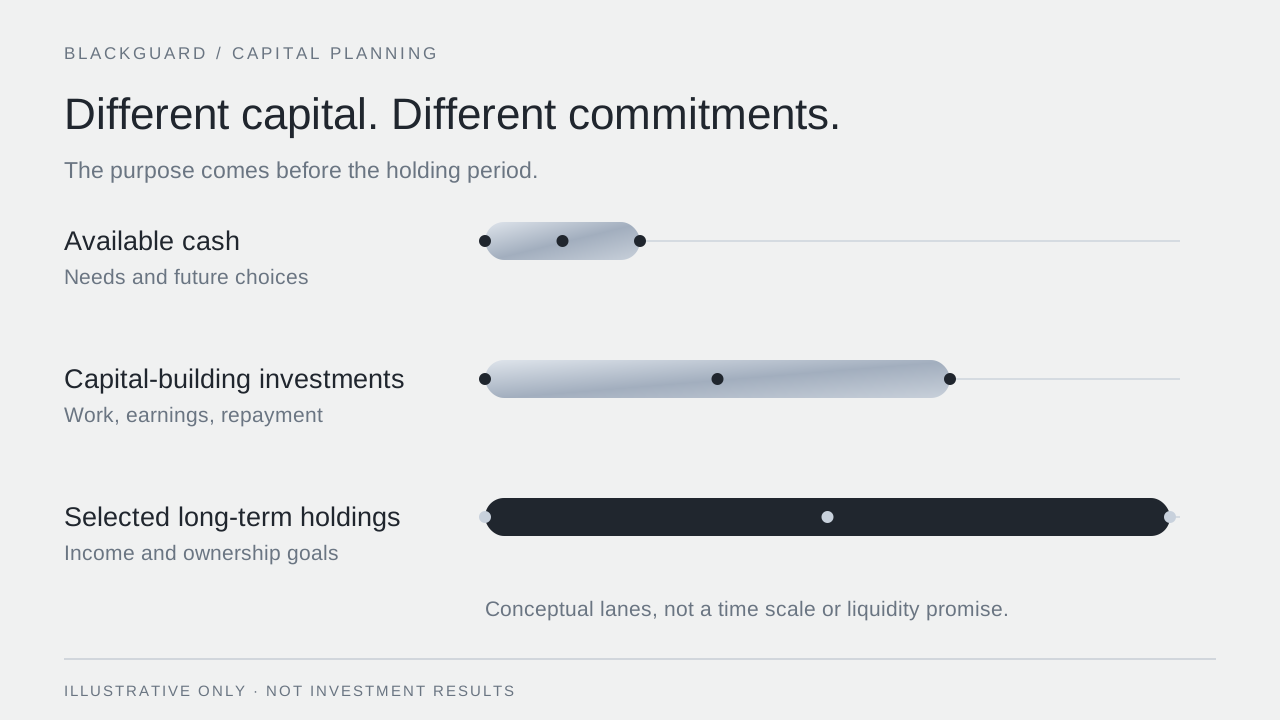
BlackGuard considers shorter-horizon opportunities alongside selected long-term holdings. That is a portfolio perspective, not a claim that one duration is always superior. The questions change with the investment, and the investor's ability to tolerate delays remains important in either case.
When does a long-term hold make sense?
A longer hold deserves consideration when the asset's demand, purchase economics, financing, and operating requirements support it. The owner should also understand the trade-off between keeping capital committed and pursuing other uses. An investment can remain worth owning even when there is no immediate reason to sell.
The difference is that the decision rests on an ongoing economic case. It does not depend on pretending a distant exit was certain from the beginning. Our perspective is straightforward: long-term ownership can be a strategy, but a ten-year sale date cannot do the strategy's work. Read how active decisions support long-term ownership for what that requires after acquisition.