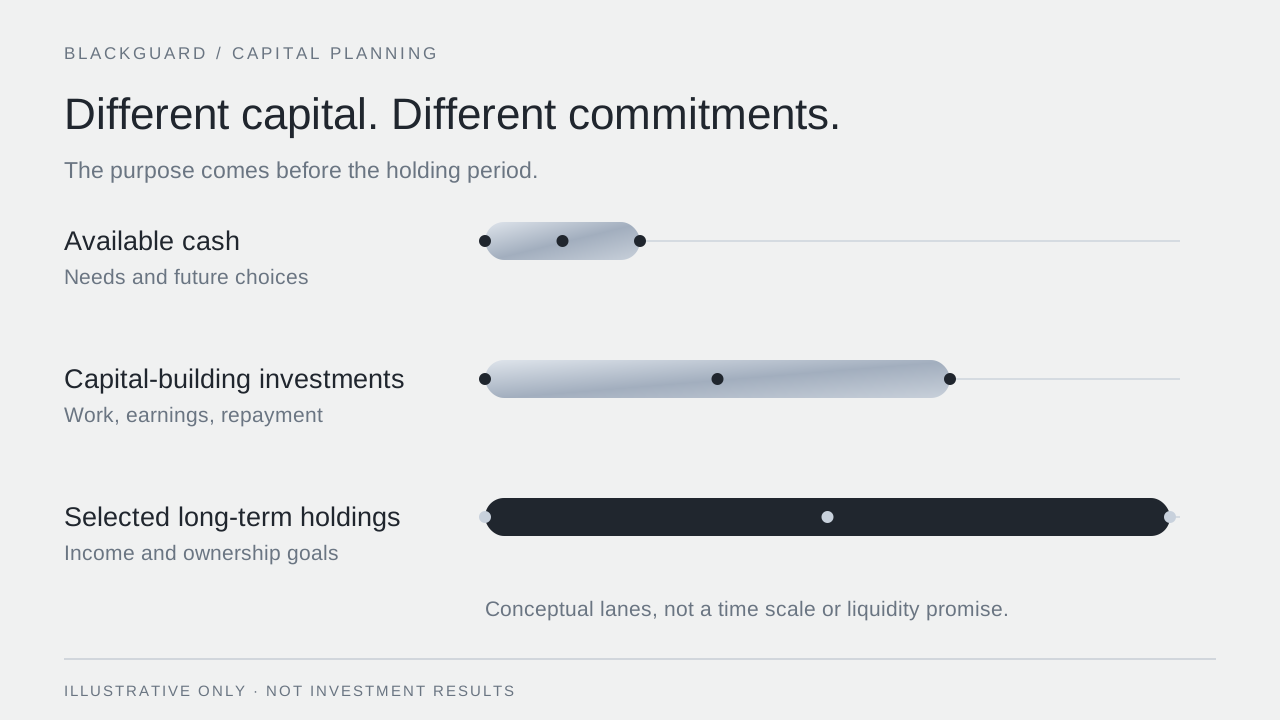
You can believe in real estate without wanting every investment to be a ten-year commitment. Some opportunities may help you build capital and move on to the next investment. Other properties may be worth owning for years. The question is what each investment is meant to do for you, and whether its holding period fits that purpose.
That is the idea behind BlackGuard's approach to different holding periods. We consider capital-building opportunities alongside selected properties for long-term ownership. We also value keeping cash available while evaluating the next opportunity. A long-term asset has to earn that commitment. It should not be the automatic next investment simply because someone has a deal ready to fund.
The goal is to put capital to work thoughtfully, reinvest available earnings when it makes sense, and remain selective about where you make a larger, longer commitment. Income, wealth preservation, and potential depreciation benefits can all play a role. They need to come from a sound investment, not carry a weak one.
Why build capital before making a long-term commitment?
Suppose you like the idea of eventually owning a meaningful interest in a high-quality apartment property. You do not have to assume that buying into the first available property is the best way to get there. There may be other suitable uses for part of your investment capital while you evaluate that longer-term decision.
When an investment pays earnings or returns capital, you have another choice to make. You can reinvest, add to available cash, or consider a longer-term holding. If the investment has been profitable, you may be making that next decision with more capital than you started with. That is the aim, not a promised result.
This is more specific than saying a mix of holding periods makes a portfolio safer. The purpose is to build capital and preserve choices before accepting a long commitment. A mix of investments still carries risk, and a shorter term does not automatically make an investment safer than a longer one.
Put your capital to work without forcing the calendar
An investor may want to earn and reinvest throughout the year, then consider a substantial long-term investment later. That can be a useful planning conversation. It should not become a deadline that forces a purchase or assumes every earlier investment will pay out exactly when needed.
Imagine reviewing your position later in the year. Some proceeds have arrived, another investment is still underway, and an attractive property is being evaluated. The decision should use the cash actually available, the quality of the property, and the commitments you already have. Expected repayments should remain separate from money you can use today.
Different investments run on different schedules. A three-to-five-year plan is still a multi-year commitment, even if it is shorter than a ten-year hold. You cannot assume that its principal will be available by year-end. The timing in the actual investment documents matters more than the label "short-term."
Cash gives you the ability to choose
Having cash available means you can consider an opportunity without first having to sell another investment or wait for a distribution. It also gives you room to say no. That matters when a purchase would tie up a meaningful share of your capital for years.
Our view is that finding something to buy and finding something worth owning are different tasks. Even when plenty of deals are being offered, the price, location, debt, and operating plan still have to work together. A busy market does not remove the need to be selective.
There is a trade-off. Cash can lose purchasing power, and holding it can mean passing up investment returns. The point is not to keep everything on the sidelines. It is to keep enough flexibility for your obligations and future choices, rather than take on an investment simply because cash is available.
A shorter investment is not a cash reserve
A private loan with an expected repayment date is still an investment. The borrower can be late, need more time, or fail to repay. Selling your position may be difficult. Money committed to that loan is not the same as money available in your bank account.
The SEC's private-placement guidance explains that these investments can be difficult to sell and may need to be held indefinitely. Before investing, understand how you would get your money back and what happens if the original plan takes longer. Keep money needed for taxes, emergencies, and other fixed obligations separate.
The SEC's asset-allocation guidance also connects your investment mix with the time you have and the risk you can accept. There is no single cash percentage that fits everyone. Your business, household needs, and other investments should help determine how much you can genuinely commit.
Compounding starts with earnings, not a projection
Compounding means that earnings become part of the money working for you. If you receive a profit and reinvest it, the next investment can put both your original capital and those earnings to work. Repeating that successfully can build your investment base over time.
But an estimated increase in a building's value is not cash you can redeploy. Nor is every distribution profit. A payment may include some of your original investment coming back. Fees, taxes, and losses also affect what is available for the next decision. Look at what you actually earned and retained.
Long-term property ownership can support compounding too, through reinvestment in the property or reinvestment of distributions. Shorter-term investments do not have a monopoly on growth. The practical difference is when money becomes available and what choices you have then. More transactions alone do not create a better result.
Give the long-term property a clear purpose
The right long-term asset can bring several goals together. You may want rental income, a durable place to hold wealth, and potential tax benefits from depreciation. A property in a hard-to-reproduce location may be worth owning through different market conditions if its purchase price and ongoing costs make sense.
Those are reasons to study an asset carefully, not promises that it will preserve your money. The building needs maintenance, residents need to keep choosing it, and its debt needs to fit the plan. One large property can also create concentration risk. A desirable address does not remove those obligations.
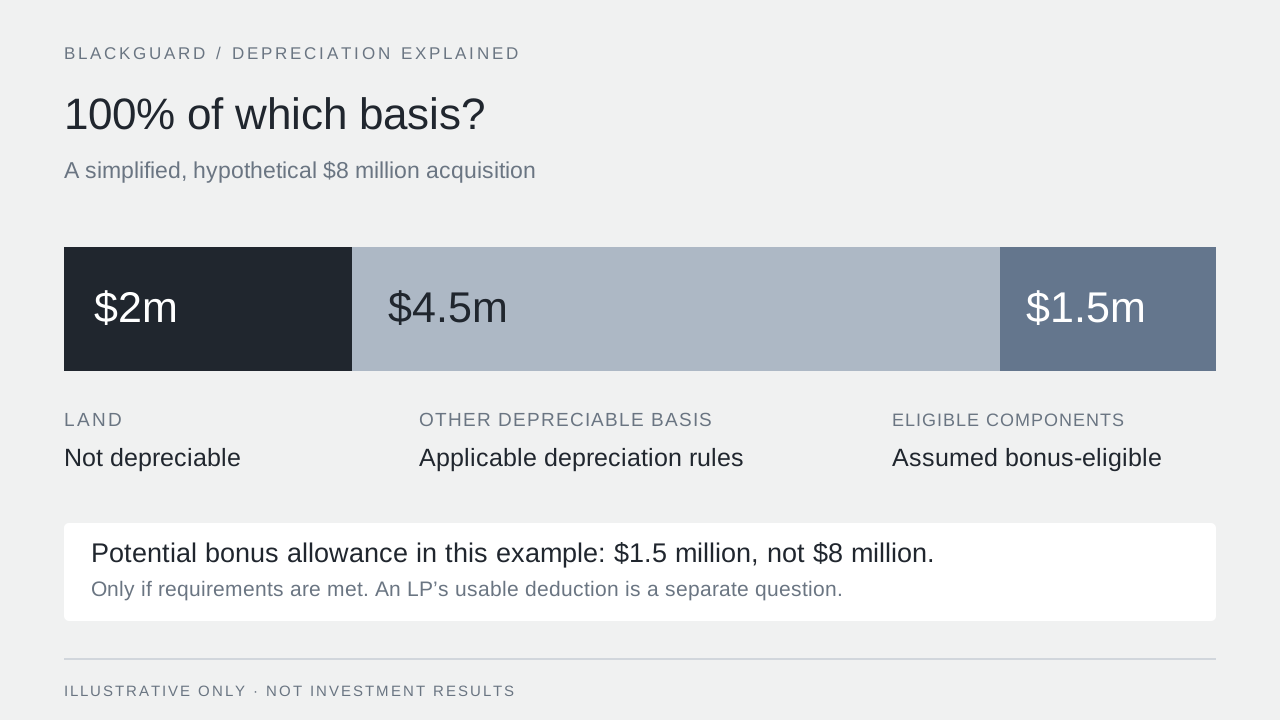
Depreciation deserves a separate review with your tax adviser. Whether you can use a deduction depends on the property, the investment structure, and your own circumstances. Moving proceeds into multifamily near year-end does not automatically offset income earned earlier. Our bonus-depreciation guide walks through those distinctions.
The point is to own by choice
We want the decision to hold a property for years to be deliberate. Build capital where the opportunity and risk make sense. Keep usable cash available. Then ask whether a particular long-term asset deserves part of that capital, rather than treating a distant sale projection as the reason to invest.
That is how the pieces fit together for BlackGuard. Capital growth creates potential choices; available cash lets you act on them; selected long-term ownership can serve income and wealth-building goals. Each step needs to make sense on its own. Read why a ten-year exit date is not a strategy for the questions we ask before making that longer commitment.