An apartment property can collect rent and send investors cash while reporting a different amount of income for tax purposes. Depreciation helps explain why. It allows certain property costs to be deducted over time, and qualifying costs may be deducted sooner. That can be valuable, but the amount on a tax projection is not automatically money back in your pocket.
This matters if you have earned money from other investments and are considering a long-term multifamily holding. You may want income, an asset worth keeping, and potential depreciation benefits together. The property still needs to be a good purchase. Your tax adviser also needs to check whether its deductions can be used against the particular income you earned.
This article explains the framework as of September 25, 2026. It is general federal-tax education, not a recommendation for an individual return. A proposed investment needs review by the investor's qualified tax adviser, including any state-law differences.
What 100% bonus depreciation actually means
The IRS's guidance on Notice 2026-11 addresses 100% additional first-year depreciation for eligible property under the law enacted in 2025. As described in Publication 946, eligibility includes acquisition and placed-in-service requirements, with the restored 100% allowance applying to certain qualifying property acquired and placed in service after January 19, 2025.
The percentage applies to eligible depreciable basis. It does not mean deducting 100% of an entire real estate purchase, and it does not mean every investor automatically deducts the amount contributed. The land, building, qualifying components, transaction structure, and relevant elections need to be considered separately.
An acquisition agreement or a year-end transfer of money does not by itself establish the placed-in-service requirement. The relevant property must satisfy the applicable rules. Timing should be supported by the actual facts, not selected because a projected deduction is needed before December 31.
Where cost segregation fits
A cost segregation analysis identifies property components and their appropriate tax treatment. Certain properly classified components may have shorter recovery periods than the building and may qualify for bonus depreciation. The whole building does not become short-lived property simply because a study is performed.
Land is not depreciable. Residential rental buildings generally have a much longer recovery period than many eligible components under the applicable depreciation system. Publication 946 explains the framework and qualifications. A professional analysis must establish classifications and basis rather than apply a standard percentage to every acquisition.
Statements that a study will always reclassify 30% or 40% of an asset should therefore be treated cautiously. Results depend on the property and supported allocations. An estimate may help frame diligence, but it is not a substitute for the completed analysis or the tax treatment of the actual transaction.
A hypothetical example separates the pieces
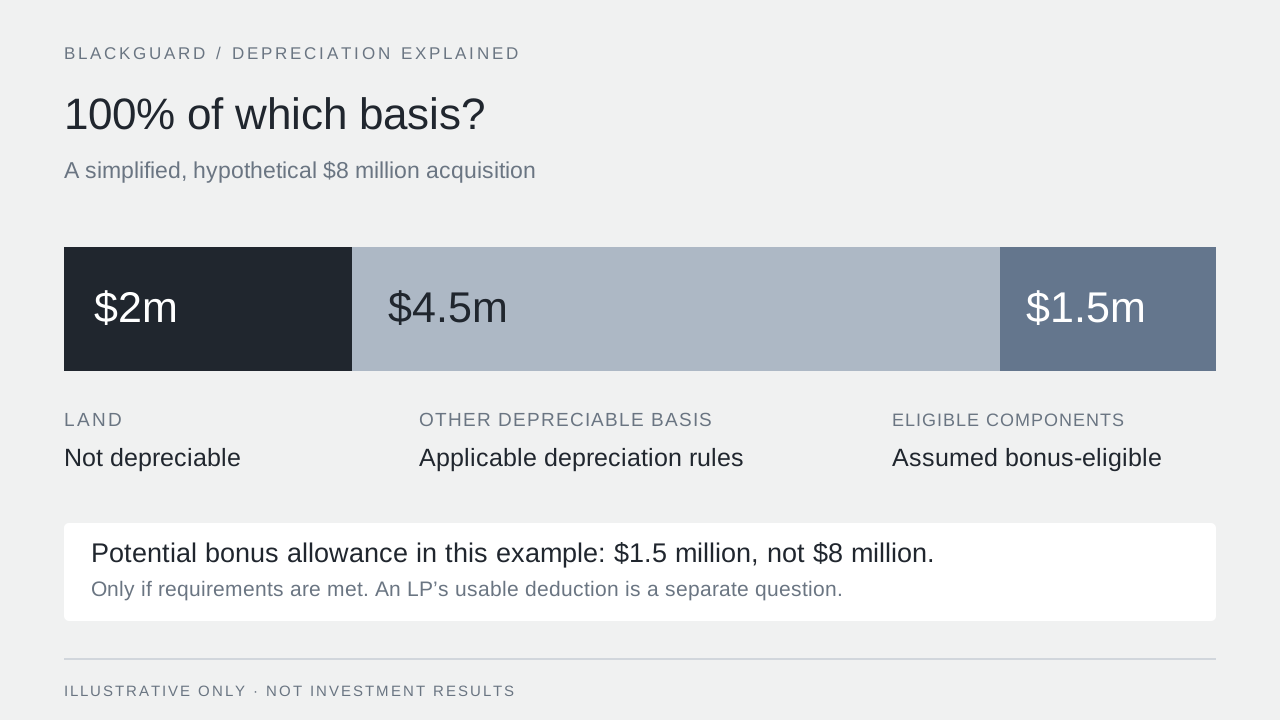
Suppose a simplified $8 million acquisition is allocated $2 million to land and $6 million to depreciable property. Assume a properly supported analysis identifies $1.5 million of components that qualify for 100% bonus depreciation under all applicable requirements. The illustration's potential bonus allowance is $1.5 million, not $8 million.
The remaining $4.5 million of depreciable basis is not ignored. It receives the depreciation treatment appropriate to its classification and circumstances. This example excludes acquisition costs, elections, allocation complexities, and other adjustments. The figures are invented to illustrate the distinction and are not a prediction of any property's cost-segregation result.
Nor does the example determine an LP's deduction. The partnership's allocations, the investor's basis and amount at risk, and other applicable limitations still matter. A percentage ownership interest or cash contribution should not be substituted for that analysis.
What the property deducts and what you can use may differ
A partnership may report income and deductions to its investors through Schedule K-1. Whether an investor can use an allocated loss in the current year depends on the applicable investor-level rules. Those rules do not disappear because the investor has a genuine equity interest.
IRS Publication 925 explains passive-activity and at-risk limitations and discusses the interaction with other loss limits. Rental activities are generally passive for these purposes, subject to exceptions. An individual's qualification for an exception requires its own factual analysis.
That distinction matters when combining strategies. A loss from a passive rental investment may be usable against eligible passive income, but it does not automatically offset salary, business income, or portfolio interest. The character of income from the earlier investment must be identified. The fact that both investments share a manager does not make their tax categories match.
A tax deduction is not the same as cash back
A deduction can reduce taxable income when it is allowable. It is not the same as a tax credit, a cash distribution, or a refund equal to its face amount. Its effect depends on the taxpayer's circumstances, tax rates, other items on the return, and when the deduction can be used.
If a loss is limited, some or all may need to be carried forward under the applicable rules rather than producing the intended current-year result. A tax projection should distinguish an allocated loss from a currently usable deduction. Otherwise, an investor may plan around cash that the tax treatment does not actually free up.
The economic investment still needs to make sense. A deduction does not compensate automatically for an excessive purchase price, weak operations, or an unsuitable commitment of capital. Tax efficiency is a component of an investment analysis, not proof that the investment is sound.
Long-term ownership does not erase future tax consequences
Depreciation generally reduces adjusted basis. A later disposition can therefore produce taxable gain and depreciation-related tax consequences. The treatment depends on the assets and transaction; ordinary-income recapture can apply to certain components. IRS Publication 544 explains these disposition rules and like-kind exchanges.
A qualifying Section 1031 exchange may defer certain gain on eligible real property when its requirements are met. It is not a universal eraser for depreciation consequences. Cash, nonqualifying property, and component-level treatment can matter. Simply reinvesting proceeds with the same manager does not create a qualifying exchange.
An exchange of partnership interests generally does not qualify as a like-kind exchange. A property-owning partnership's transaction is a different question from an LP changing investments. Any proposed exchange should be structured with qualified tax and legal professionals before the transaction proceeds, not assumed after a distribution arrives.
How does this fit BlackGuard's broader approach?
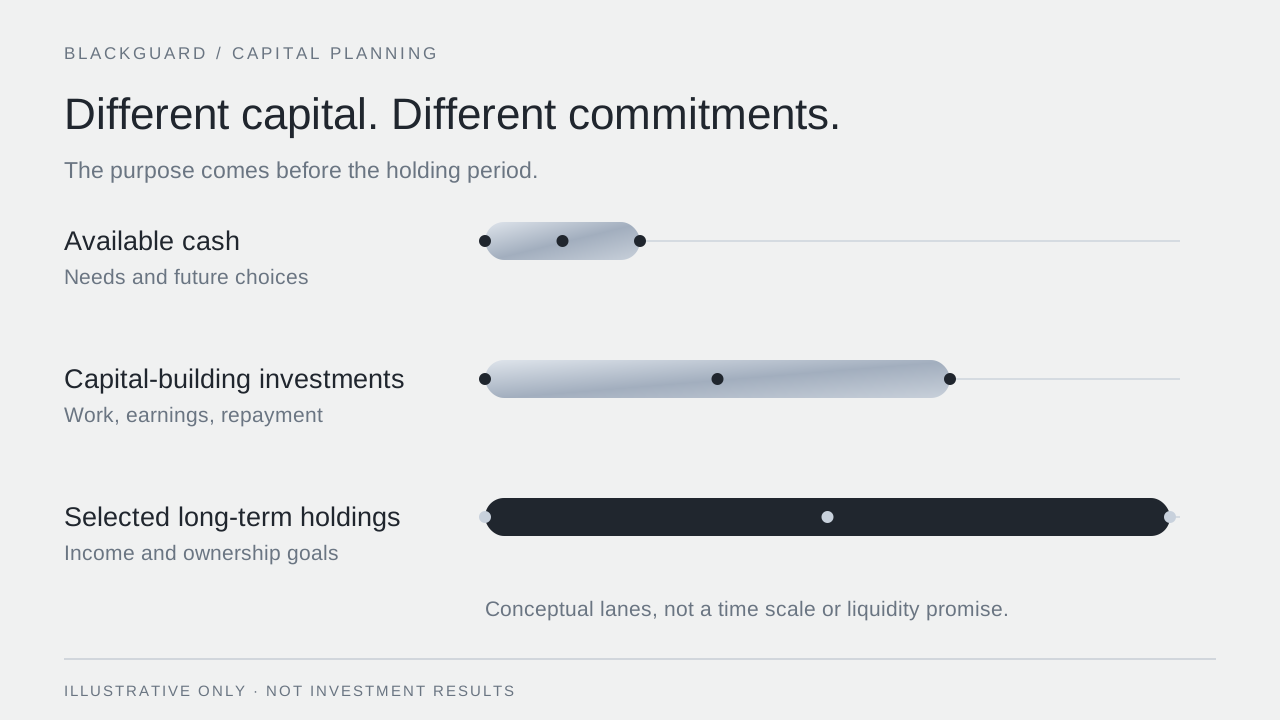
BlackGuard considers shorter-horizon opportunities and selected long-term ownership as different parts of a broader capital-allocation discussion. When available proceeds are considered for reinvestment, the next opportunity needs its own economic and tax review. There is no automatic year-end offset built into moving money from one strategy to another.
For a proposed multifamily investment, investors can ask for the anticipated property classification, timing, tax reporting, and assumptions behind any projected deductions. Their advisers can then evaluate how those assumptions interact with their own income and limitations. Projections should remain identified as projections until the relevant facts and analysis are established.
The useful planning question is not merely whether bonus depreciation exists. It is whether a particular investment, held in a particular structure by a particular taxpayer, supports the intended result. That is where disciplined ownership planning begins.