Imagine being told that a project is on schedule, then learning that the contractor and lender have different information. One is waiting for an approval. The other is waiting for a document everyone thought had already been sent. A polished dashboard does not solve that problem. Getting the right information to the right person does.
This hypothetical situation captures a practical test for technology-enabled management. Does the system help people know what is true, what requires attention, and who is responsible for the next action? If it does not, another interface may add activity without improving execution.
At BlackGuard, we want technology to help the work move: fewer lost documents, clearer responsibilities, and faster answers to questions that are holding up a decision. The aim is better execution. Software does not replace the person who must check the facts, make the decision, and follow through when something goes wrong.
Start with a task that needs to improve
A useful technology discussion begins with a recurring problem. Perhaps key information arrives in inconsistent formats, a review waits without a clear owner, or a material change is not reflected in the next decision. Name the problem before selecting a tool.
For a hypothetical acquisition, the task might be reconciling a property's rent information with the operating model. The desired result is not merely faster extraction of numbers. It is a reviewable explanation of the figures used, the period they cover, and any differences that need attention.
That distinction helps separate a demonstration from useful operating capability. A tool can appear impressive while requiring more correction than the old process. Evaluate the result in the workflow where it will be used, including exceptions, missing documents, and the people who must rely on the output.
Can you trace the number back to its source?
Information becomes more useful when the reader can trace it to its source. A figure should have an identifiable document, date, and interpretation. If different records disagree, the conflict should remain visible until someone resolves it. Quietly choosing the most convenient number is not an efficiency improvement.
In the hypothetical acquisition, one file may report billed rent while another reflects cash received. Both can be accurate and still answer different questions. A system that merges them without preserving the distinction can make the analysis less reliable, even if it produces an attractive summary quickly.
Investors can ask to see how a manager handles that kind of difference. The objective is not access to every internal file. It is confidence that material conclusions have a reviewable basis and that uncertainty is not removed simply to produce a cleaner presentation.
Spend less time waiting for the next person
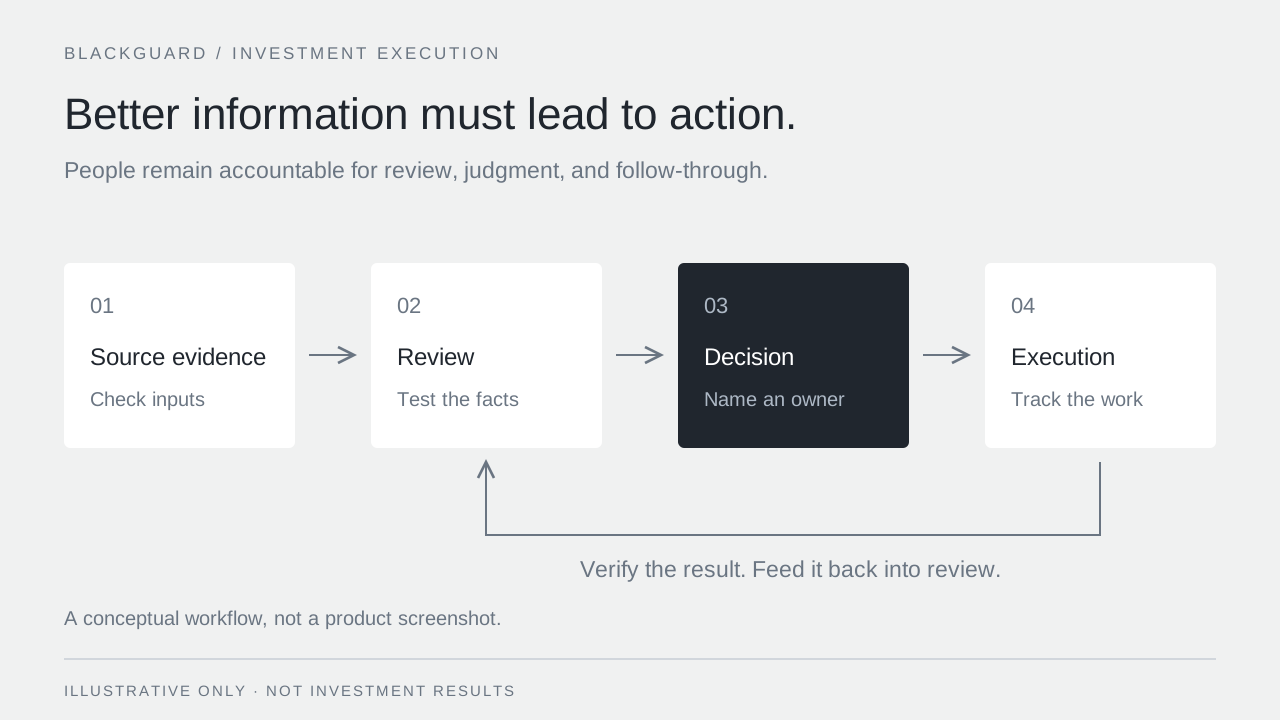
Much of execution involves handoffs. Someone collects information, another person reviews it, and a third decides what happens next. Technology can make the owner, status, and dependency visible. It can also help distinguish a request that was sent from one that was received, accepted, or completed.
For a renovation project, a purchase order might be prepared while the required approval is still outstanding. Calling the item ordered can create the wrong expectation about delivery. A useful workflow keeps those states separate and shows what must happen before the next milestone.
Speed matters when it reduces unnecessary delay and allows a better-informed decision. It does not justify skipping review or hiding an exception. A fast incorrect answer may create more work later, along with costs that are difficult to see in a simple measure of processing time.
AI still needs limits and review
Artificial intelligence can assist with certain information tasks, but its output needs evaluation appropriate to the consequence of being wrong. An apparently confident summary can omit a qualification or misinterpret a document. The fact that a system produced an answer does not establish that the answer is reliable.
The NIST AI Risk Management Framework offers a voluntary approach to managing risks associated with AI systems. It is useful background for thinking about evaluation, oversight, and responsible use. Referencing it here does not claim that BlackGuard has a certification or a particular AI system in production.
In an investment workflow, identify what a tool may assist with and what requires a responsible reviewer. Sensitive information also needs appropriate access controls and handling. The practical standard is a process that can explain and correct an error, not a promise that technology will never make one.
Measure a better process with meaningful evidence
Metrics should reflect the work. How long does a review take from receipt of complete information to a decision? How often do errors require rework? Which dependencies repeatedly delay execution? How quickly does a material change reach the people responsible for acting on it?
Keep those measures distinct from investment outcomes. Reducing a document-review delay does not establish a higher return, and faster reporting does not make an asset less risky. Operating evidence can show that a process improved without proving that every investment using it will perform well.
The SEC's private-placement guidance encourages investors to examine management and the reasonableness of an issuer's claims, including reliance on technology. A technology narrative should withstand the same diligence as the property and financial assumptions it accompanies.
Who is responsible for getting it done?
An integrated management approach should explain responsibilities across the actual process. Who owns underwriting, execution, monitoring, and communication? Which work is performed internally, and which depends on outside professionals? Where does a handoff occur, and who remains accountable for following it through?
Those questions matter even when several functions sit under one company. Internal ownership does not automatically produce good coordination. Outside expertise does not automatically prevent it. The quality of the process depends on clear responsibilities, reliable information, and the ability to address problems when they occur.
For BlackGuard, the emphasis is on connected oversight and timely decisions. This article describes the principles behind that approach. It is not a claim that every function is owned in-house or that an automated platform controls every part of an investment.
Ask for a concrete example
The most useful conversation about technology often follows one decision from beginning to end. What information was needed? How was it checked? What uncertainty remained? Who made the decision? How did the team confirm that the resulting work was completed?
A manager should be able to discuss the process without relying on futuristic language or a screen full of charts. The details will vary by investment and may include confidential information that cannot be shared. The operating logic should still be understandable.
Our view is that real estate expertise and better tools belong together. Technology is an opportunity to improve the way the work gets done, while the asset remains subject to market, financing, and execution risk. For a related question, read why long-term ownership still requires active decisions.