New floors and better appliances can make an apartment more appealing. They cannot give the person renting it a raise. Before counting on higher rent to make an investment work, ask a simple question: can enough people afford the apartment after the improvements, and would they choose it over the alternatives?
Consider a hypothetical apartment community where management plans a substantial interior upgrade. The design may be attractive and the construction may be executed well. The remaining question is whether enough households want that product at the required rent, given the alternatives and the rest of their budgets.
That is why we look at the household budget as well as the renovation budget. A good operating team can improve maintenance, leasing, and the experience of living in a property. It cannot create better-paying jobs across the neighborhood. We want a plan that recognizes that limit before asking investors to fund the work.
People need housing they can actually afford
Housing demand involves both the need for a place to live and the ability to pay for the available product. A market can have substantial housing need while a particular rent level remains difficult to support. Treating those facts as contradictory can lead to weak conclusions about an investment.
The Census Bureau's September 2024 release using 2023 ACS data reported that 49.7% of renter households for which rent burden was calculated spent more than 30% of income on housing costs. Those are historical national figures. They do not describe current conditions at a particular property, but they show why household budgets deserve attention.
For a local investment, use evidence relevant to the intended residents and product. Compare achievable rents with the housing choices available nearby. Examine whether the proposed upgrade serves existing demand or requires attracting a substantially different resident base. The second plan may be possible, but it should be identified as a different task.
The same rent can become harder to pay
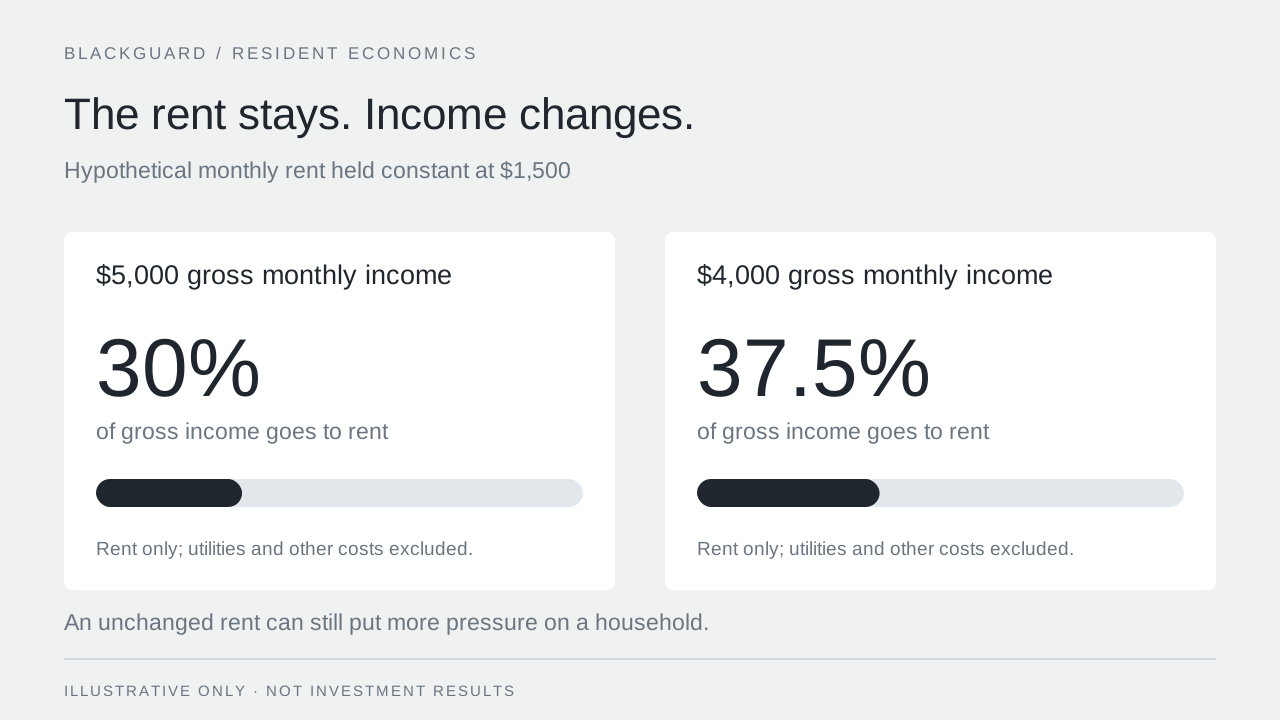
Imagine monthly household income of $5,000 and rent of $1,500. Rent alone consumes 30% of gross income. If income falls to $4,000 while rent remains $1,500, the share rises to 37.5%. The apartment has not changed. The household's ability to absorb the cost has.
This is a hypothetical arithmetic illustration, not a local rent estimate or a full affordability test. It excludes utilities, taxes on income, transportation, childcare, debt payments, and other expenses. Those omissions matter. Two households with the same gross income can have very different amounts available for housing.
For underwriting, the lesson is to examine the resident's budget rather than assume a fixed rent is equally manageable under every economic condition. A forecast for growing rent should explain what supports it. The presence of a renovation budget does not answer that question.
Advertised rent is not the same as rent collected
An advertised rent may differ from the economic result after concessions, vacancy, collection issues, and operating expenses. A model should make those distinctions visible. Otherwise, an apparently successful increase can hide weaker performance elsewhere in the property.
In the hypothetical community, renovated units might attract inquiries at the new asking rent but take longer to lease. Management may respond with concessions. That does not automatically mean the renovation failed, but it changes the economics and deserves comparison with the original assumptions.
Ask whether the owner is measuring the right outcome. The relevant question may be the cost and time required to produce sustainable occupied income, not the highest rent shown in a listing. A practical operating review connects the leasing evidence with the actual cash requirements of the investment.
What happens if the area's main employer struggles?
A local economy can depend heavily on particular employers or industries. That exposure belongs in the demand analysis, along with other sources of employment and reasons people choose the area. It does not justify predicting layoffs or a recession without evidence.
Instead, test the investment's sensitivity to weaker household income or slower household formation. What would happen to leasing, renewals, and concessions if residents became more cost-conscious? Which competing products might become attractive? How much room does the capital structure provide to respond?
This is scenario analysis. It should be labeled that way. A downside case is useful because it reveals dependencies, not because it claims to know the future. The same discipline should apply to an optimistic forecast that assumes stable demand and rising income over a long period.
The owner has a budget too
Resident affordability is only one side of the equation. Property taxes, insurance, repairs, utilities paid by the owner, staffing, and debt service can also affect the ability to operate at a given rent. Improving one line item does not necessarily offset pressure across the others.
An owner may face the difficult combination of residents who cannot absorb higher rents and expenses that continue to rise. That is why a purchase price and financing structure that require uninterrupted rent growth deserve careful review. An investment needs a plan for less convenient conditions.
The Federal Reserve's November 2025 discussion of commercial real estate included refinancing concerns even as some market indicators were stabilizing. The report is historical context, not a current claim about this property's market. It reinforces the need to evaluate operating conditions alongside financing rather than assume one favorable signal resolves every risk.
Are Class B and Class C apartments necessarily bad investments?
No. An asset-class label is not a conclusion about price, demand, management, or financing. Older apartments may serve a significant housing need. They can also require substantial repairs and operate with limited room for cost increases. Newer or higher-priced properties have their own demand and valuation risks.
The useful question is what needs to be true for this particular investment to work. Does the property provide a competitive product at a rent residents can sustain? Is the physical condition understood? Are the reserves and financing appropriate for the work? Is the expected return heavily dependent on future rent growth or resale assumptions?
BlackGuard's perspective is to evaluate those requirements directly. We are interested in selected long-term holdings with a credible operating case, not a blanket promise that a property becomes safe because it carries a higher-end label.
Better products need workable economics
Affordable housing can involve better layouts, different delivery methods, different financing, or more efficient operations. Each proposal needs to be examined on its own terms. A lower advertised price may conceal trade-offs; an unfamiliar product may meet a genuine need. Neither should be accepted or dismissed by reflex.
For an investor, this means looking beyond the renovation checklist. Understand the resident's choices, the owner's obligations, and the financing that connects them. Technology and good execution can help management work with better information. They do not create income in the surrounding economy. Read how new housing products change competition for the next part of the discussion.